📘 Unit 4: Functions and Graphs – Review Exercise 4 (Solved)
Prepared by Muhammad Tayyab, Subject Specialist Mathematics, Govt Christian High School Daska. Based on PECTAA 2026 syllabus (National Curriculum 2023).
📖 What's Inside: Complete review of Unit 4: MCQs on functions, composition, inverses; absolute value graphs; solving equations & inequalities; real-world applications (profit break-even, discount, GPS accuracy).
📚 Related Resources – Unit 4: Functions and Graphs
1 Choose the correct answer for each question.
| Q.No | Question | A | B | C | D | Correct |
|---|---|---|---|---|---|---|
| 1 | \( f(x) = \frac{5x-6}{3} \), then \( f(3) = \) | \(-1\) | \(3\) | \(9\) | \(15\) | B |
| 2 | A function \( f \) from \( X \) to \( Y \) is represented by: | \( f:XY \) | \( f:Y \to X \) | \( f:X \to Y \) | \( f:\frac{X}{Y} \) | C |
| 3 | \( (f \circ g)(x) = \) | \( (f+g)(x) \) | \( (f-g)(x) \) | \( f(g(x)) \) | \( f(x) \div g(x) \) | C |
| 4 | If \( f(x)=2x+3, g(x)=x+1 \), then \( f(x)+g(x)= \) | \( 3x \) | \( 3x+4 \) | \( 4 \) | \( 2x^2+3 \) | B |
| 5 | If \( f(x)=5x+2, h(x)=2x-2 \), then \( f(x)-h(x)= \) | \( 3x \) | \( 5x^2-4 \) | \( 3x+4 \) | \( -3x-4 \) | C |
| 6 | If \( f(x)=3x+1, g(x)=2x \), then \( g(x) \times f(x)= \) | \( 6x+2x \) | \( 5x^2+1 \) | \( x+1 \) | \( 6x^2+2x \) | D |
| 7 | If \( f(x)=x^2-4, g(x)=x+2, x\neq -2 \), then \( \frac{f(x)}{g(x)}= \) | \( \frac{1}{x-2} \) | \( \frac{1}{x+2} \) | \( x+2 \) | \( x-2 \) | D |
| 8 | Shape of absolute value function graph? | U-shaped | V-shaped | L-shaped | M-shaped | B |
| 9 | Vertical line test for a function: every vertical line intersects at: | 4 points | 3 points | 2 points | 1 point | D |
| 10 | If \( f(x)=x^3 \), then \( f(-2)= \) | \(-8\) | \(8\) | \(4\) | \(-6\) | A |
\[ \begin{aligned} &\textbf{Q1: } f(3)=\frac{5(3)-6}{3}= \frac{15-6}{3}=3 \quad \Rightarrow \text{(B)}\\[4pt] &\textbf{Q2: } \text{Function from }X\text{ to }Y: f:X \rightarrow Y \quad \Rightarrow \text{(C)}\\[4pt] &\textbf{Q3: } (f \circ g)(x)=f(g(x)) \quad \Rightarrow \text{(C)}\\[4pt] &\textbf{Q4: } f(x)+g(x)=2x+3+x+1=3x+4 \quad \Rightarrow \text{(B)}\\[4pt] &\textbf{Q5: } f(x)-h(x)=5x+2-(2x-2)=3x+4 \quad \Rightarrow \text{(C)}\\[4pt] &\textbf{Q6: } g(x)\times f(x)=2x(3x+1)=6x^2+2x \quad \Rightarrow \text{(D)}\\[4pt] &\textbf{Q7: } \frac{f(x)}{g(x)}=\frac{x^2-4}{x+2}=x-2 \;(x\neq -2) \quad \Rightarrow \text{(D)}\\[4pt] &\textbf{Q8: } |x| \text{ graph is V-shaped } \Rightarrow \text{(B)}\\[4pt] &\textbf{Q9: } \text{vertical line test: at most 1 point } \Rightarrow \text{(D)}\\[4pt] &\textbf{Q10: } f(-2)=(-2)^3=-8 \quad \Rightarrow \text{(A)} \end{aligned} \]
2 \( f(x)=25-x^{2} \), \( g(x)=5+x \) — operations & evaluation
(i) \( f(x)+g(x) \)
\[ \begin{aligned} f(x)+g(x) &= (25 - x^{2}) + (5 + x) \\ &= -x^{2} + x + 30 \end{aligned} \]
(ii) \( f(x)-g(x) \)
\[ \begin{aligned} f(x)-g(x) &= (25 - x^{2}) - (5 + x) \\ &= 25 - x^{2} -5 - x \\ &= -x^{2} - x + 20 \end{aligned} \]
(iii) \( f(x)\cdot g(x) \)
\[ \begin{aligned} f(x)\cdot g(x) &= (25 - x^{2})(5 + x) \\ &= 125 + 25x -5x^{2} - x^{3} \\ &= -x^{3} -5x^{2} + 25x +125 \end{aligned} \]
(iv) \( \frac{f(x)}{g(x)} \)
\[ \begin{aligned} \frac{f(x)}{g(x)} &= \frac{25 - x^{2}}{5 + x} = \frac{(5-x)(5+x)}{5+x} \\ &= 5 - x, \quad x \neq -5 \end{aligned} \]
(v) \( f(7) \)
\[ \begin{aligned} f(7) &= 25 - (7)^{2} = 25 - 49 = -24 \end{aligned} \]
(vi) \( g(-8) \)
\[ \begin{aligned} g(-8) &= 5 + (-8) = -3 \end{aligned} \]
3 Composition: \( f(x)=x^{3},\; g(x)=14+2x \)
(i) \( (f \circ g)(x) \)
\[ \begin{aligned} (f\circ g)(x) &= f(g(x)) = f(14+2x) \\ &= (14 + 2x)^{3} \end{aligned} \]
(ii) \( (g \circ f)(x) \)
\[ \begin{aligned} (g\circ f)(x) &= g(f(x)) = g(x^{3}) \\ &= 14 + 2x^{3} = 2(7+x^{3}) \end{aligned} \]
(iii) \( (f \circ f)(x) \)
\[ \begin{aligned} (f\circ f)(x) &= f(f(x)) = f(x^{3}) \\ &= (x^{3})^{3} = x^{9} \end{aligned} \]
(iv) \( (g \circ g)(x) \)
\[ \begin{aligned} (g\circ g)(x) &= g(g(x)) = g(14+2x) \\ &= 14 + 2(14+2x) = 14+28+4x \\ &= 4x + 42 = 2(2x+21) \end{aligned} \]
4 Find \( f^{-1}(x) \)
(i) \( f(x)=9x-1 \)
\[ \begin{aligned} y &= 9x-1 \;\Rightarrow\; y+1 = 9x \\ x &= \frac{y+1}{9} \;\Rightarrow\; f^{-1}(y)=\frac{y+1}{9} \\ \therefore\; f^{-1}(x) &= \frac{x+1}{9} \end{aligned} \]
(ii) \( f(x)=\frac{5}{x-1},\; x\neq 1 \)
\[ \begin{aligned} y &= \frac{5}{x-1} \;\Rightarrow\; y(x-1)=5 \\ xy - y &=5 \;\Rightarrow\; xy = 5+y \\ x &= \frac{5+y}{y} \;\Rightarrow\; f^{-1}(y)=\frac{5+y}{y} \\ \therefore\; f^{-1}(x) &= \frac{5+x}{x} \end{aligned} \]
(iii) \( f(x)=\sqrt{x-5},\; x\ge 5 \)
\[ \begin{aligned} y &= \sqrt{x-5} \;\Rightarrow\; y^{2}=x-5 \\ x &= y^{2}+5 \;\Rightarrow\; f^{-1}(y)=y^{2}+5 \\ \therefore\; f^{-1}(x) &= x^{2}+5,\; x\ge 0 \end{aligned} \]
(iv) \( f(x)=\frac{3-x}{2} \)
\[ \begin{aligned} y &= \frac{3-x}{2} \;\Rightarrow\; 2y = 3-x \\ x &= 3-2y \;\Rightarrow\; f^{-1}(y)=3-2y \\ \therefore\; f^{-1}(x) &= 3-2x \end{aligned} \]
5 Graph absolute value functions
(i) \( f(x)=7|x| \) Vertex at \((0,0)\), V-shaped symmetric.
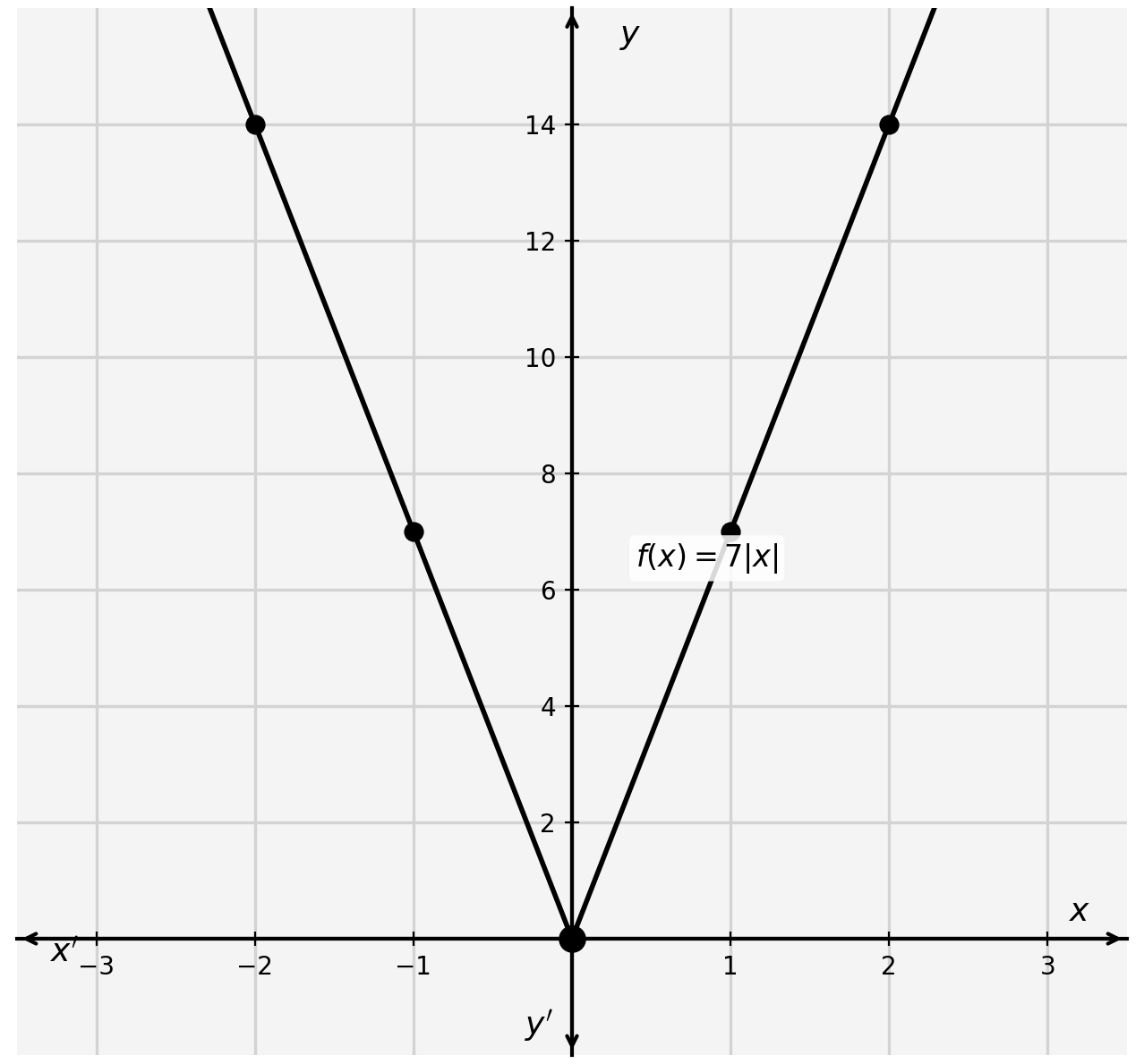
Graph: \( f(x)=7|x| \)
(ii) \( f(x)=|x+6|-2 \) Vertex \((-6,-2)\), opens upward.
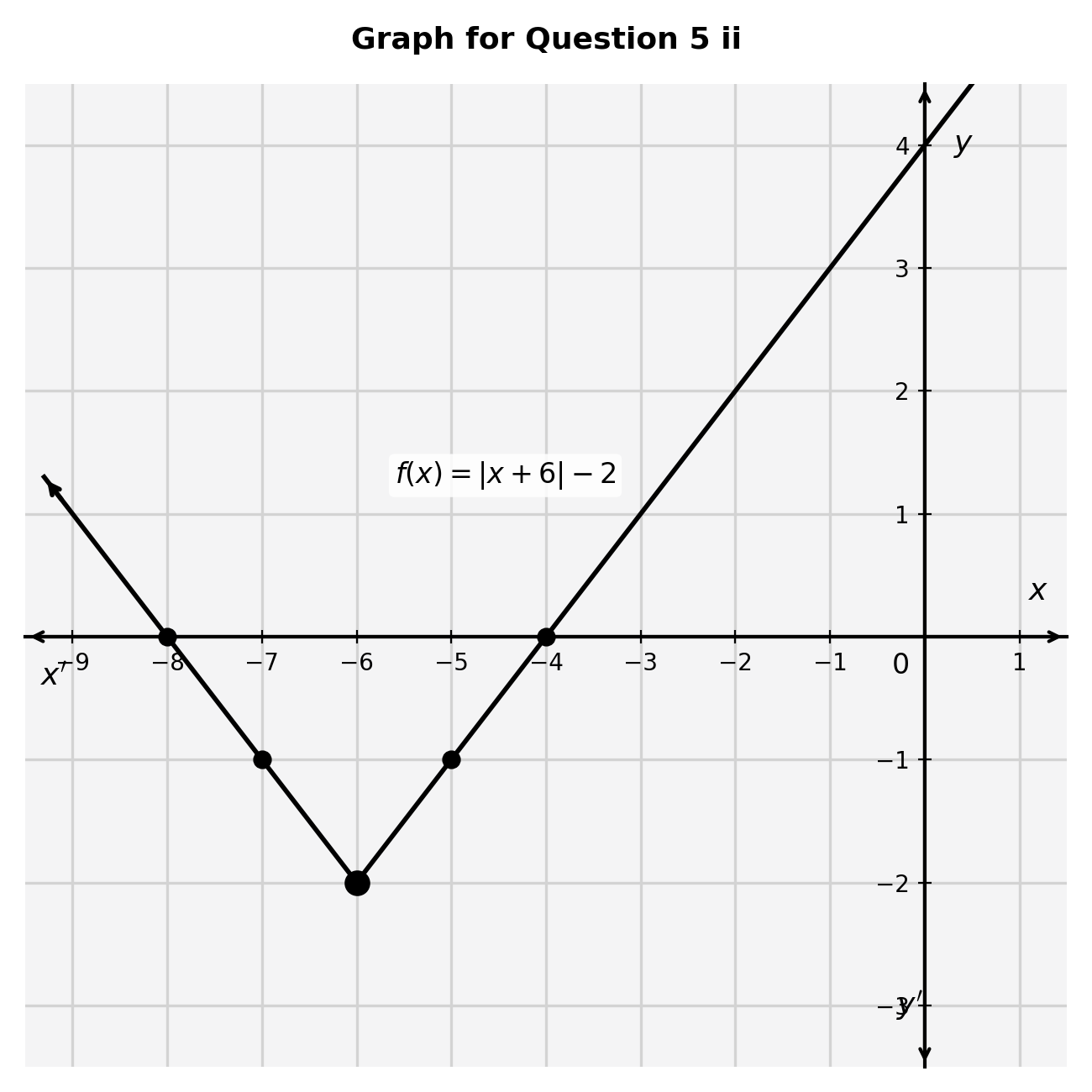
Graph of \( |x+6|-2 \)
Note: The vertex occurs at \(x=-6\) and the graph is symmetric about vertical line \(x=-6\).
6 Solve \( |3x-2|=1 \) and \( |6x+1|=9 \) (number line)
(i) \( |3x-2| = 1 \)
\[ \begin{aligned} 3x-2 = 1 &\;\text{or}\; 3x-2 = -1 \\ 3x=3 &\;\Rightarrow\; x=1 \\ 3x=1 &\;\Rightarrow\; x=\frac{1}{3} \end{aligned} \]
Solution set: \( \left\{\frac{1}{3},\;1\right\} \)
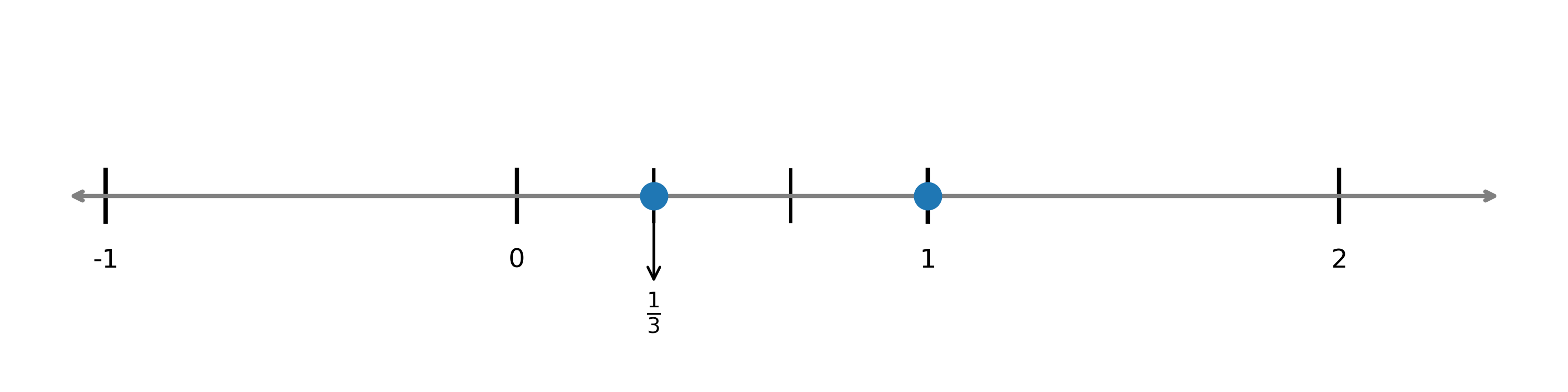
(ii) \( |6x+1| = 9 \)
\[ \begin{aligned} 6x+1 = 9 &\;\Rightarrow\; 6x=8 \;\Rightarrow\; x=\frac{4}{3}=1\frac{1}{3}\\ 6x+1 = -9 &\;\Rightarrow\; 6x=-10 \;\Rightarrow\; x=-\frac{5}{3}=-1\frac{2}{3} \end{aligned} \]
S.S = \( \left\{ -1\frac{2}{3},\; 1\frac{1}{3} \right\} \)

7 Solve inequalities \( |7-2x|\le 1 \) and \( |6x+18|\le 24 \)
(i) \( |7-2x| \le 1 \)
\[ \begin{aligned} -1 \le 7-2x \le 1 &\;\Rightarrow\; -8 \le -2x \le -6 \\ \text{multiply by } -1 &: 8 \ge 2x \ge 6 \;\Rightarrow\; 3 \le x \le 4 \end{aligned} \]
Interval: \([3,4]\)

(ii) \( |6x+18| \le 24 \)
\[ \begin{aligned} -24 \le 6x+18 \le 24 &\;\Rightarrow\; -42 \le 6x \le 6 \\ &\;\Rightarrow\; -7 \le x \le 1 \end{aligned} \]
Solution: \([-7,\;1]\)

8 \( f(x)=3x+7 \) : inverse and intersection
(i) \( f^{-1}(x) \)
\[ \begin{aligned} y &= 3x+7 \;\Rightarrow\; y-7=3x \\ x &= \frac{y-7}{3} \;\Rightarrow\; f^{-1}(x)=\frac{x-7}{3} \end{aligned} \]
(ii) Solve \( f(x)=f^{-1}(x) \)
\[ \begin{aligned} 3x+7 &= \frac{x-7}{3} \\ 9x+21 &= x-7 \\ 8x &= -28 \\ x &= -\frac{7}{2} \end{aligned} \]
Hence \( x = -\frac{7}{2} \).
9 Break-even analysis: \( P(x)=100x-10000 \)
\[ \begin{aligned} P(x) &= 0 \\ 100x - 10000 &= 0 \\ 100x &= 10000 \\ x &= 100 \end{aligned} \]
✅ The company must sell 100 items to break even.
10 Discount function: \( D(p)=0.85p \), original price Rs.2000
\[ \begin{aligned} D(2000) &= 0.85 \times 2000 \\ &= 1700 \end{aligned} \]
Selling price after 15% discount: Rs. 1,700
11 GPS accuracy: \( |100 - r| \le 6 \)
\[ \begin{aligned} |100 - r| &\le 6 \\ -6 &\le 100 - r \le 6 \\ -106 &\le -r \le -94 \\ 94 &\le r \le 106 \end{aligned} \]
The acceptable reported location \( r \) lies in \( [94,\;106] \) metres.
📐 Key Formulas – Unit 4 Summary
Composite Function: \( (f \circ g)(x) = f(g(x)) \)
Inverse Function: \( f^{-1}(x) \) satisfies \( f(f^{-1}(x)) = x \)
Absolute Value Equation: \( |X| = a \Rightarrow X = \pm a \) (if \( a\ge0 \))
Absolute Value Inequality: \( |X| < a \Rightarrow -aa \Rightarrow X<-a \text{ or } X>a \)
Unit 1✨ Complex Numbers
Unit 2Quadratic Equations
Unit 3Matrices & Determinants
Unit 4📗 Functions (Ex 4.1)
Unit 4📊 Absolute Value (Ex 4.2)
Unit 4📈 Linear Models (Ex 4.3)
Unit 4🔄 Review Exercise (Current)
Unit 5Algebraic Fractions
Unit 6Vectors in Plane
Unit 7Trigonometry
Unit 8Chords & Arcs
Unit 9Tangent & Angles
Unit 10Practical Geometry
Unit 11Information Handling
Unit 12Probability
Created by Hira Science Academy | Aligned with PECTAA 2026 Syllabus